|
National Foster Parent Association Newsletter - March 2026 |
 |
|
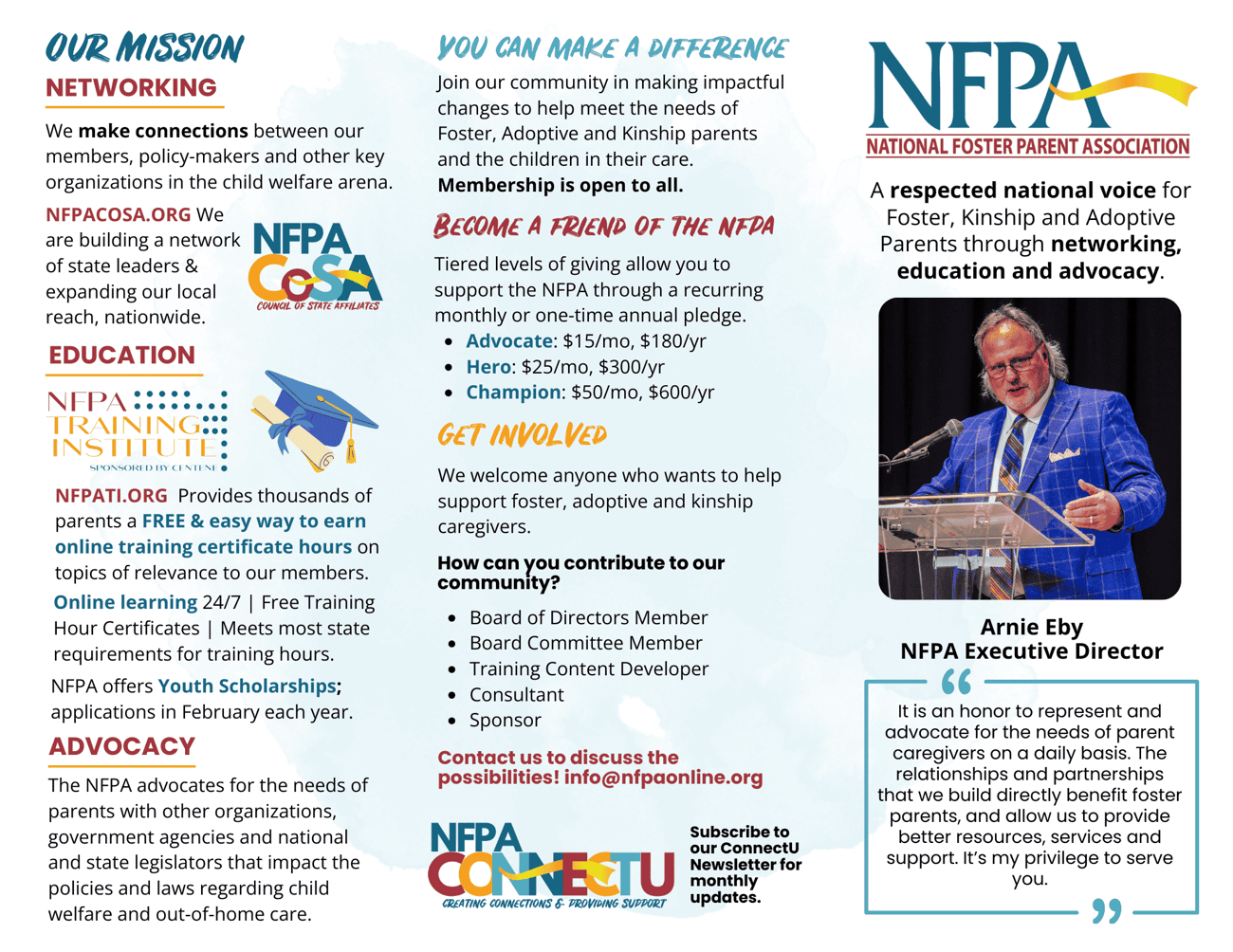
The NFPA is a respected national voice for Foster, Adoptive and Kinship Parents through Networking, Education and Advocacy. |
|
|
|
 |
|
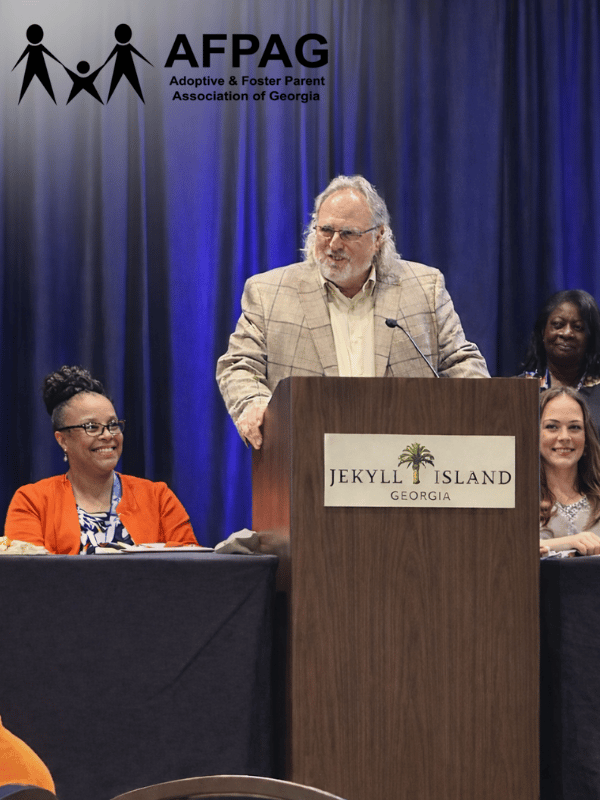
Arnie Eby, NFPA Executive Director
at the Adoptive & Foster Parent Association of Georgia's Annual Conference, 'Empowering Adoptive and Foster Families' |
|
|
|
 |
|
|
 |
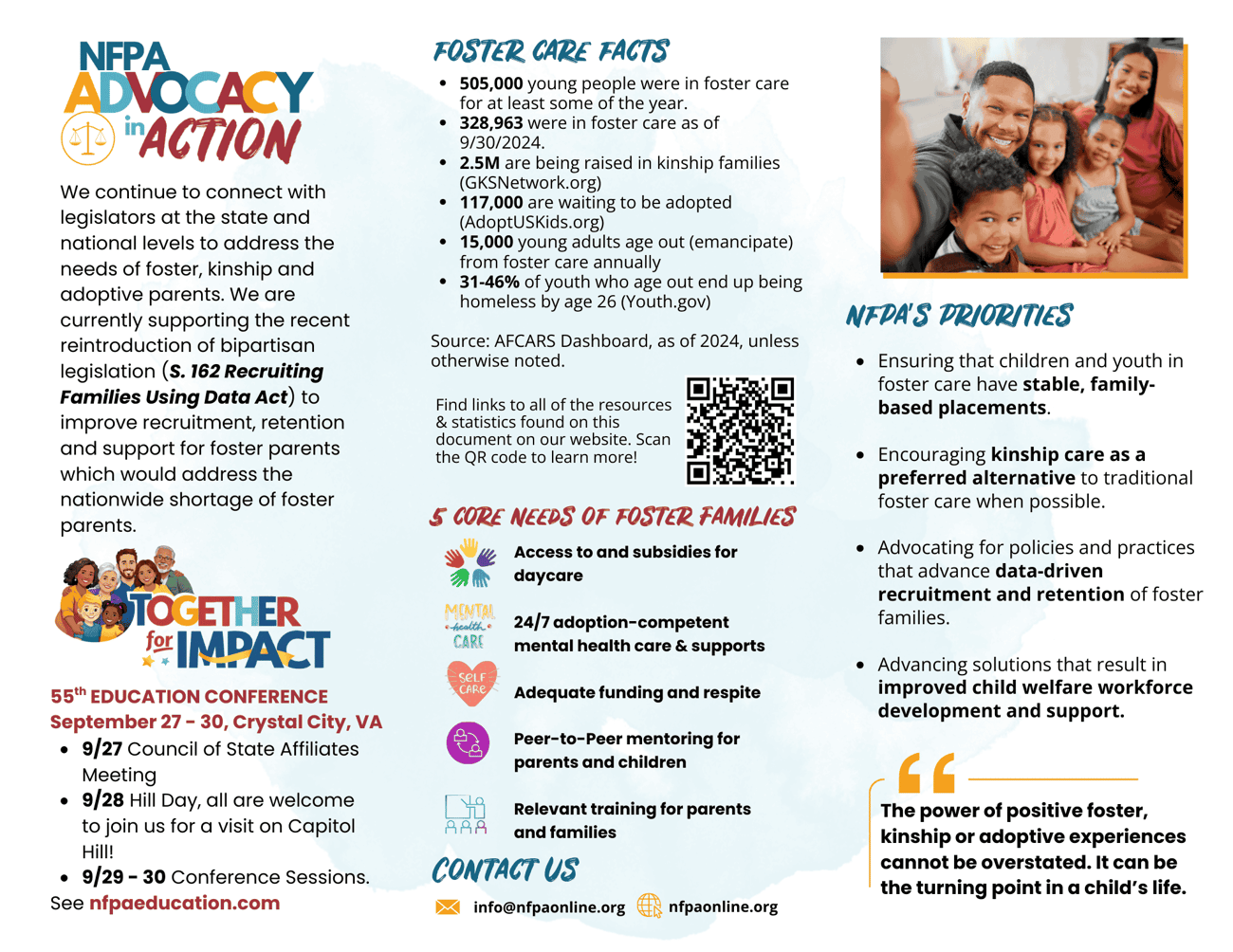
We are actively planning for our 55th Education Conference in September. Save the Date to join us September 27th - 30th in Crystal City, Virginia.
This year is all about creating real IMPACT for caregivers. We know that by working together and pooling our talents we can create the biggest impact of all. Opportunities to gather with fellow Foster, Adoptive and Kinship parents is important, as is the chance to hear from policy makers and experts in the field. We'll be working together with FASD United for this year's event.
Schedule
Sunday, September 27th
Council of State Affiliates meeting, FASD United Networking ‘Poster Session’.
Monday, September 28th
NFPA Capitol Hill Visitation Day – everyone is welcome! Join the NFPA for this rare opportunity to visit contacts on The Hill in Washington, D.C., and accompany us as we meet with key legislative contacts.
FASD United Red Shoes Gala
Tuesday, September 29th – Wednesday September 30th
Conference Presentations.
Visit https://nfpaeducation.com for details.
|
|
|
 |
|
|
 |
|
A Message from Journey to Success
We’re excited to share that Journey to Success has launched a new Bipartisan Foster Youth Agenda landing page — a one-stop shop to track recently introduced legislation and find advocacy tools to help advance the new bipartisan bills moving in Congress.
You’ll find:
-
Bill summaries & links to sponsor press releases
-
A ready-to-use social media toolkit (graphics + sample posts)
-
Journey to Success talking points on Chafee & ETV
-
Links to recordings + PPT slides of recent federal policy webinars on Chafee, ETV and extended foster care, and related policy resources
JTS continues to engage in advocacy around the implementation of the Executive Order on Fostering the Future. Here’s a link to the statement we issued on Tuesday in conjunction with the State of the Union, where the First Lady hosted a young leader from S.C.
|
|
|
|
|
March is Social Worker Appreciation Month!
Everyone in the caregiver space has been touched by a social worker.
We take this month to honor their compassion, resilience, and dedication, and to recognize their tenacity in standing beside children and families every day. Their advocacy, guidance, and unwavering commitment help to bring stability and hope to children in times of crisis.
Thank you for strengthening communities and changing lives through your service, and your heart. |
|
|
|
|
Get Your Copy!
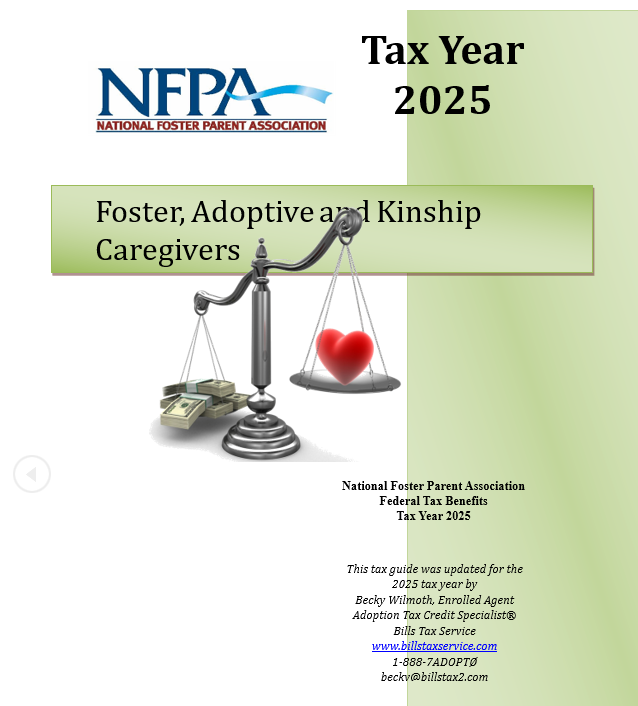
2025 Federal Tax Guide for Foster, Adoptive and Kinship Parents |
|
|
Our newest Tax Guide is available. |
 |
|
Our thanks go out to our friends at Bill's Tax Service, who annually provide Caregivers with guidance on making the most of the tax season. |
 |
|
Get the Best Deductions Possible on your 2025 Tax Return!
Our Tax Guide is FREE to Members, and available for purchase by non-Members for just $35. You'll receive a Regular Membership to the NFPA with your purchase.
These annual tax guides are prepared specifically for the NFPA audience - Foster, Adoptive and Kinship parents. They outline the deductions you are eligible to receive, expenses you are allowed to utilize as a write off, how your work as a foster parent is considered a Charitable Contribution and what that means for you, and much, much more.
Keep an eye on our Tax Info page for updates from our contacts at the IRS and partner organizations - we'll continue updating this page through the tax season, so be sure to bookmark it! |
| Get Your 2025 Tax Guide |
|
|
|
A former NFPA Board Member says:
After 12 years of foster parenting, I found the tax guide instrumental in saving me $1,000 the year I found it and nearly $10,000 the following year. The membership tax guide pays for the entire NFPA membership year after year. |
|
Here are some additional tax-related resources to get you started.
|
|
|
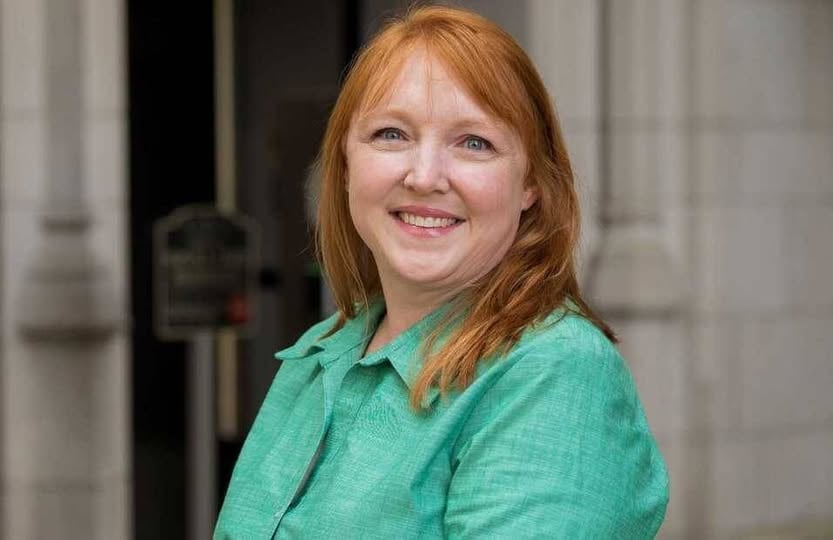
Congratulations to NFPA's Council of State Affiliates lead, Amanda Cruce, on achieving her Doctorate! |
 |
|
From the University of Pittsburgh School of Social Work Facebook Page
Congratulations to Dr. Amanda Cruce who successfully defended her dissertation "Beyond Safety and Permanency: Assessing Flourishing Among Sexual and Gender Minority Youth in Foster Care."
A special thanks to her Committee: Chair, Dr. Betsy Farmer and Drs. Deborah Moon, Mary Beth Rauktis, and Robert Coulter. Said Farmer "a warm send off and congratulations as Amanda begins the next phase of her life and career – as an Assistant Professor in the School of Social Work at the University of South Florida in Tampa. As many of you know, Amanda has dedicated her career to improving child welfare – she’ll now have a new opportunity and platform to do this, back in her home state, working with community partners, and teaching the next generation of leaders and practitioners!" Usf SocialWork |
|
|
 |
Pets in Homes That Are Providing Foster Care
In summer 2025, this newsletter asked if parents who had foster children in the home and pets would be willing to talk to a researcher about their experiences with pets and children in the home. Mary Beth Rauktis, a social work researcher from the University of Pittsburgh contacted you by email and text, sending a survey and interviewing some of you about your experiences and what you have observed with your foster children and pets.
The reason for the research was to better understand the relationship between pets in the foster home and children and youth, and what the benefits were as well as challenges. Fifteen individuals were interviewed and over fifty individuals completed the survey asking about their relationship with pets, the child’s relationship, child behavior, the benefits of having pets in the foster home and what foster parents saw as challenges. These are some of the preliminary results (below). She welcomes feedback from you, and if there is interest in a Zoom meeting that can be arranged!
There are four important roles that pets in the foster home play. The first is that pets are bridges/connectors or doors into the foster home for children/youth. Particularly when children are new to the home or to foster care, having a pet provides a focus for adult and child attention and by observing what the pet is doing or how it is acting, the parent can comment about the animals, creating a bond between the humans.
Pets are also teachers and coaches. Teaching happens in a multitude of ways, from teaching about grief and death, to teaching how to play, how to care for another living being through routines and pet chores.
Pets are sources of unconditional comfort. They don’t judge and affection is offered without punishment or conditions. Along with comfort is the unconditional companionship and friendship that the pet provides. Comfort is usually physical, but also psychological, when a child is in the hospital but can face time with a beloved pet.
Pets are also at times therapists, particularly for younger children who have developmental delays and strive to walk, using small motor skills to engage with the animal. One foster parent described how the cat in the home was a motivator for her child to crawl and eventually walk. They can also provide a safe space for children to regulate emotions, as when a child with attention problems would go mirror the birds to reduce his energy and get focused. He would also read to them when he needed to reduce his anxiety.
However, there were challenges, specifically when the pet became a causality of emotional dysregulation or an object of deliberate abuse or neglect. Approximately a third of those surveyed and interviewed reported instances in which an animal was on the receiving end of kicking, hitting, yelling, or inappropriate holds (trapping, squeezing) or delusions. The episodes of animal abuse were few but serious and resulted in the removal of the child from the foster home.
There is also an important mediating factor which is the pet him/herself. Interaction is a two-way street with the child synchronizing behavior with the animal, and vice versa. If a child wants the dog to sleep with them and the dog wants to sleep in his bed in the kitchen, this a -synchronicity could lead to disappointment and actions that could be harmful such trapping the dog in the room, or in a trunk. Ages of the animals, history, personality and breeds are also factors that impact how benefits and challenges are experienced.
Finally, the foster parent plays an important role in keeping everyone safe and connected. Because parents rarely know a child’s history with animals, it is best to take a cautious approach with initial separation and then supervising time with the animal. Foster parents also must know their pets and what will stress them and take actions to reduce stress through separation, boundaries and behavior correction with the child.
Some good resources are from the San Diego Humane Society. From the UK, Preparing Dogs and Children: How to Introduce Dogs to Children includes signs of stress in dogs. Jackson Galaxy has a series of videos on children and cats in the home. The overall message regardless of species is slow introduction, modeling behavior and telling the child when the animal is stressed, preparation for spaces for animals to go and be safe, and the most important is supervision in the introductory period. |
|
|
|
|
 |
|
|
 |
|
|
 |
 |
Real love doesn’t trick you: Recognizing peer-on-peer harm online
Know2Protect Campaign Champions,
February marked Teen Dating Violence Awareness Month but exploitation, abuse, neglect and violence against youth deserves year-round attention. To that end, we want to highlight how unhealthy relationships can unfold in digital spaces. Warning signs can appear online first — including monitoring social media, demanding passwords, coercive texting, threatening to share private images or using technology to harass, shame or control a partner.
Technology can amplify that harm. About 1 in 12 U.S. high school students experienced physical and/or sexual dating violence within the past year, according to the U.S. Centers for Disease Control and Prevention. About 28% of teens in a romantic relationship report being victims of digital dating abuse, including controlling messages, online monitoring and public humiliation, according to the Cyberbullying Research Center.
The message to teens is clear: Real love doesn’t trick you. It doesn’t pressure someone for explicit images, it doesn’t demand passwords or constant location sharing, it doesn’t threaten, manipulate or exploit trust for clicks, control or retaliation. With this in mind, Know2Protect wants to equip you and your networks with resources to help identify potential risks in relationships between teens and their peers. The intent is to spark conversations to keep kids and teens safe online.
While many relationships between youth are normal and nonviolent, some situations — including breakups — can escalate in unexpected ways. From nonconsensual image sharing to deepfakes and doxxing, recognizing online risks and knowing how to respond if someone you know becomes a victim is important. Remind them that they are not alone and it is never their fault.
Kids and teens deserve to be safe and help is available now. Check out these Know2Protect resources for help:
How2Spot Peer-on-Peer Risks: A Guide for Teens and Tweens provide information on common tactics used in peer-on-peer criminal activity, the risks involved and what to do if you have experienced online child sexual exploitation and abuse (CSEA).
You’re Never Alone Support Directory for Youth offers support resources and outlines steps to take if kids or teens feel unsafe or uncomfortable online.
If you or someone you know is experiencing domestic violence, contact the Love is Respect hotline at 1-866-331-9474 or text LOVEIS to 22522. If you are in immediate danger, call 911. |
|
|
 |
Have you signed up for a FREE NFPATI account? If not, head on over, sign up and start learning today! It's available 24/7, and you'll receive a certificate for each course that you complete. Almost 41,000 certificates of completion have been awarded! |
|
|
 |
|
|
|
|
 |
LAST CALL!
ATTACh Conference 2026
'Healing Connections, The Heart of the Matter'
Registration for the April, 2026 ATTACh conference is open, secure your seat for this April 9 - 11 conference. The NFPA is partnering in the development of the sessions that are dedicated to healing developmental trauma and attachment. Visit their web page to learn more. Print the event flyer HERE. |
| Register for the Conference |
|
|
|
|
Bill to Follow in the 119th Congress
(2025 - 2026) |
S.162 - Recruiting Families Using Data Act
Status: Formerly HR 579 This bill has passed the House and is now known as S 162 now that it's in the Senate, and is sponsored by Senator Chuck Grassley.
Makes the diligent recruitment plan requirements of Title IV-B more robust and requires states to use a data-driven approach for identifying potential foster parents.
The NFPA has been actively involved in the presentation of this bill to the House of Representatives, and will continue to follow and support it now that it's in the Senate. |
|
|
 |
|
|
|
|
Share ConnectU With Your Network! |
|
|
|
Visit the NFPA ConnectU Archive of past editions HERE. |
|
Received this newsletter via a forward? Subscribe to ConnectU HERE. |
|
Wish to share this edition of ConnectU on your social networks? Visit THIS PAGE for an image and direct link to an online version. |
|
|
Become a Friend of the NFPA |
|
We are committed to working to ensure that foster families have the support and services they require to best meet the needs of the children in their care.
By joining as a Friend of the NFPA at the tier that best suits you - Champion ($50/mo), Hero ($25/mo) or Advocate ($15/mo) - you become a vital partner in helping us to provide those supports. Learn more here. |
|
|
Need copies of our NFPA Trifold for your next event?? |
|
|
|
|
|
Would you like to include information about the National Foster Parent Association in your conference or meeting materials?
Please see THIS PAGE to either download a printable file that you can print directly (feel free to print any number you'd like), or to request copies of the TriFold from the NFPA. Requests are subject to our available inventory. |
|
|
|
|
|
|
|
|
|
|
|
|